When Problems Take Root: Focus on What You Can Control
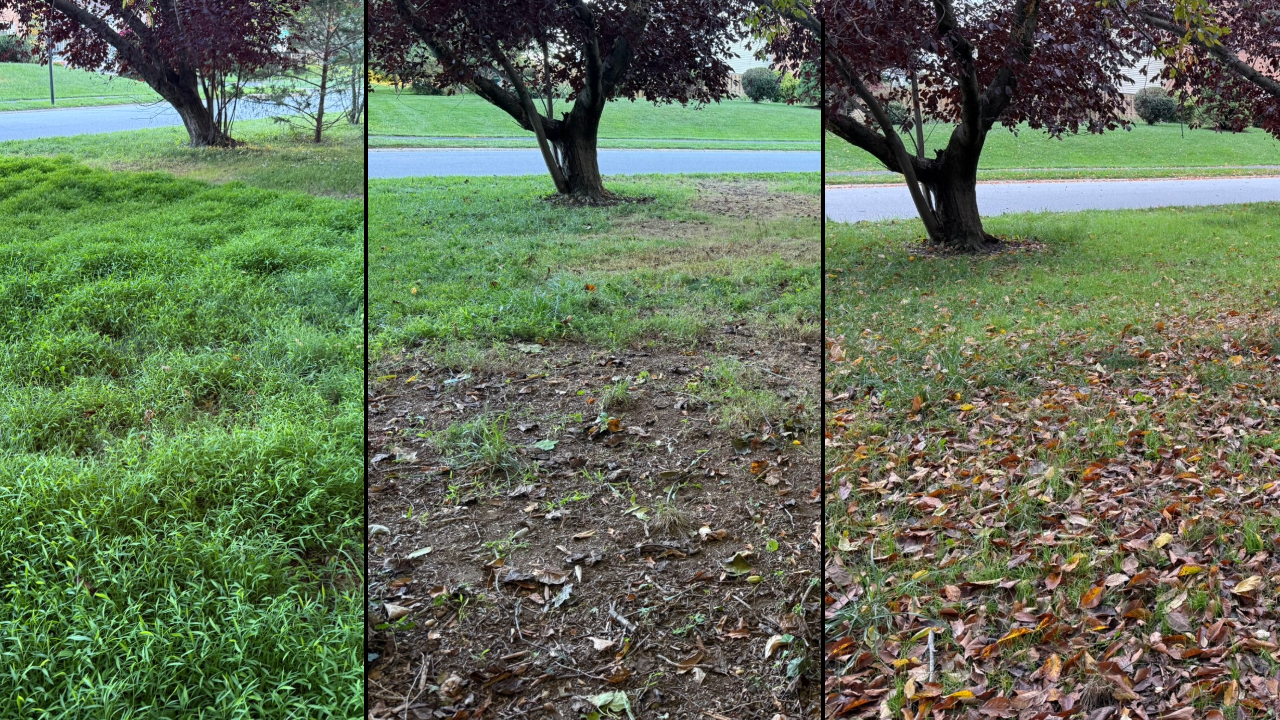
Photograph by Chad C. Carmack
The waves at the beach keep coming. Just like the waves, projects, information requests, general maintenance, schedule overload, urgent situations, family emergencies, and more keep coming. Have you ever felt overwhelmed? I know I have. It's always a good idea to remember we can only control what we can control. Some things are beyond our control.
Microstegium vimineum, Japanese stiltgrass, covered a large section of my yard. One day I looked up, and it was there. I'm sure it took a long time to get onto my property, but in my mind, it just happened. I guess I wasn't paying attention.
Japanese stiltgrass comes from Asia. In Asia, it's not a problem. It fits perfectly into the ecological community. It has to compete with other plants. In the United States, the ecological community is different. Unlike in Asia, it doesn't face competition. Animals, insects, and other plants in the United States do not readily slow it down. It can form a thick carpet of grass.
Records show it arrived in packing materials from Asia in Knoxville, Tennessee, around 1918. The seeds started spreading. It is currently widespread throughout the eastern United States. Without continued management, it will keep spreading.
It survives only one year because it's an annual. However, it thrives because it produces so many seeds, which makes it dominant.
From my perspective, it overtook my lawn slowly, then all at once. I knew one thing for sure: I needed to act, or it would completely cover my yard ─ ground cover I don't want.
After researching the plant, I started noticing it far beyond my lawn. I saw it in forests and along roadsides. After I pointed out my problem, others from other states shared that they also had Japanese stiltgrass.
My research also uncovered how to get rid of it. It felt overwhelming to learn that the best way to remove it was to pull it out by hand. I had to do this before the seeds could create more problems next year.
I got to work, and after days of pulling plants, I cleared most of the invasive plant.
What can we learn from my experience with Japanese stiltgrass?
Focus on What You Control
We do not control everything. We can only control things within our influence. Focusing on problems beyond your control wastes energy. After a century, this invasive plant is a big problem in the eastern United States. The battle to remove it seems hopeless. Those managing it have to focus on their area. Looking at the problem more broadly only causes stress. It feels out of control ─ I quit! This is the wrong way to think.
To keep perspective, when we face a massive problem, we need to focus on what we can control. I felt confident about managing my lawn rather than all the forests, fields, and lawns in my community. I only need to get it off my lawn and property.
Consider: How Did I Not See This Coming?
We can learn from our mistakes. How did I not see it coming? Many problems creep up on us until all of a sudden they become a major issue. As leaders, we need to stay on the lookout and ask good questions, like, "Is this going to be a bigger problem if I don't deal with it now?"
Solving those pesky problems takes uncomfortable effort, but we need to act.
Finally, we need to get in the habit of being aware that this might not be fun, but we need to do it. I had to pull the grass by hand. For big problems, use resources to find the best way to solve them. But most importantly, take action. Pull the plant.
Although it wasn't fun, dealing with the Japanese stiltgrass in my yard led me to some thoughts about problem-solving principles. Deal with what you can control; some variables are always uncontrollable. Watch for small problems that grow into huge ones, and even if it feels overwhelming, you still need to act.
If you see an invasive grass in your lawn, get out there and start pulling. You got this!
Martial Arts Perspective
People train in martial arts for many reasons. Some want to learn self-defense, while others focus on the physical fitness benefits. Still others want something for themselves. They have busy lives, and martial arts is that something. Parents want their kids to learn self-discipline, leadership, focus, goal setting, and perseverance. All martial arts students should consider what they can control in their martial arts journey. By identifying what they can control, they can focus their energy on those areas. For example, students have some control over how much time they spend training outside the martial arts facility. By spending more time training, they can become better martial artist. The same principles learned in martial arts apply in the real world. Focusing on and acting on what you can control is essential to success.
Questions
What areas of your life do you control? What areas of your life do you not control? Can this information be useful?
Why is it important for a person to have awareness of what they control and what they do not control?
What actions can you take to increase your control over a difficult situation?
When you have to take action, how do you prioritize those actions?
Have you ever let a small problem become a big problem? Suppose you could change the outcome before the problem got out of hand. What would you have done differently?
